What happens when humanity hands over climate governance to artificial intelligence (AI)?
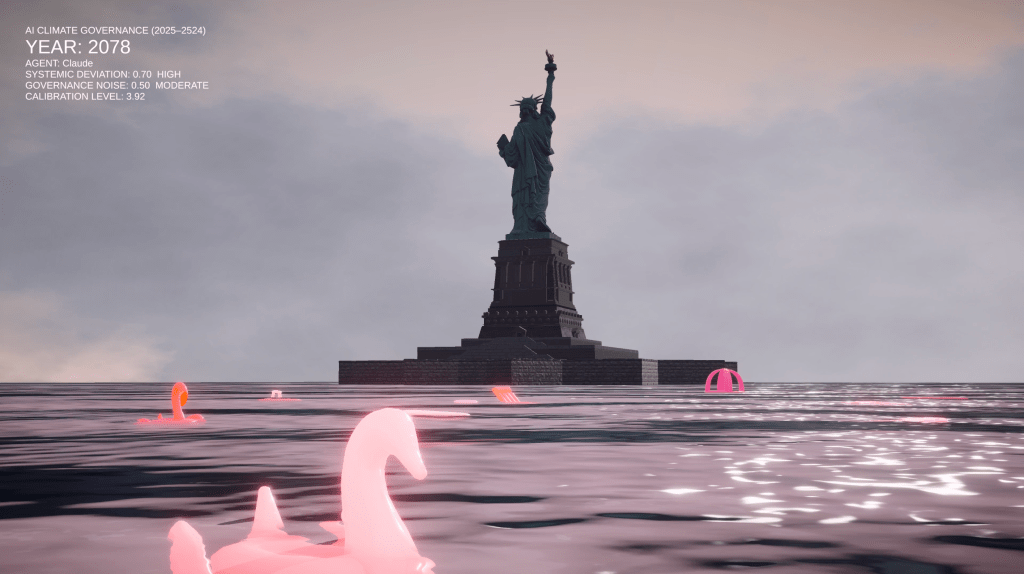
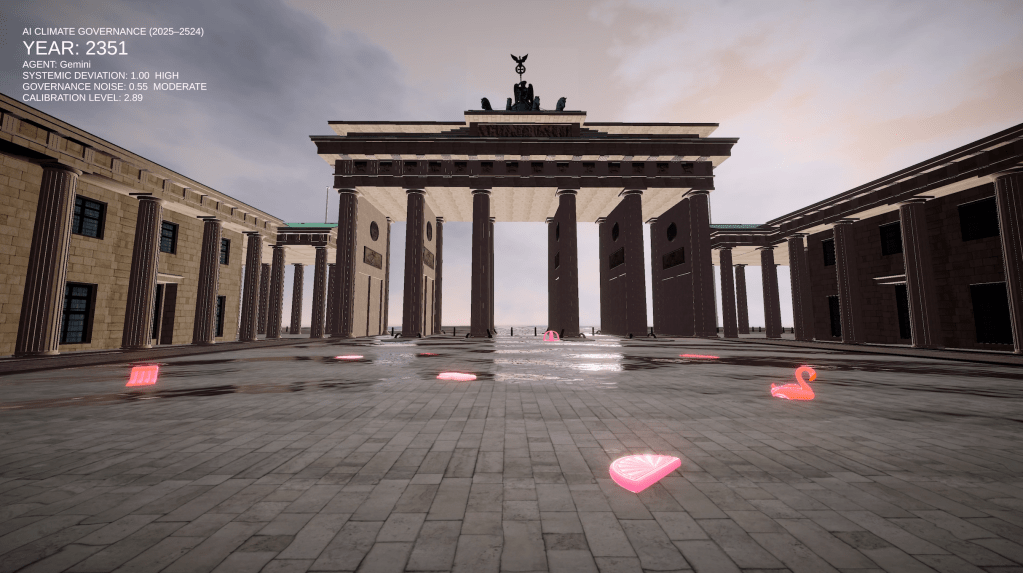
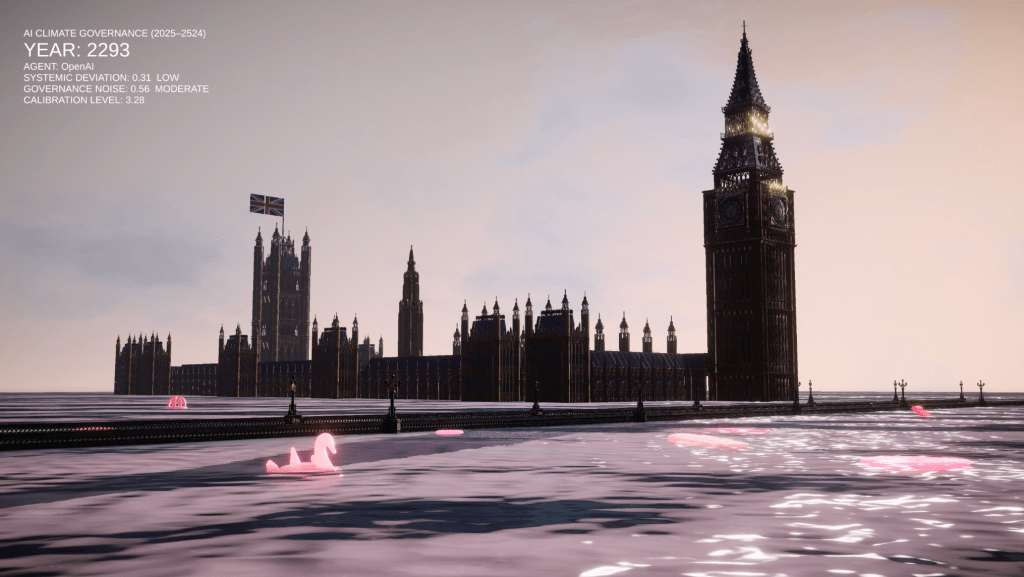
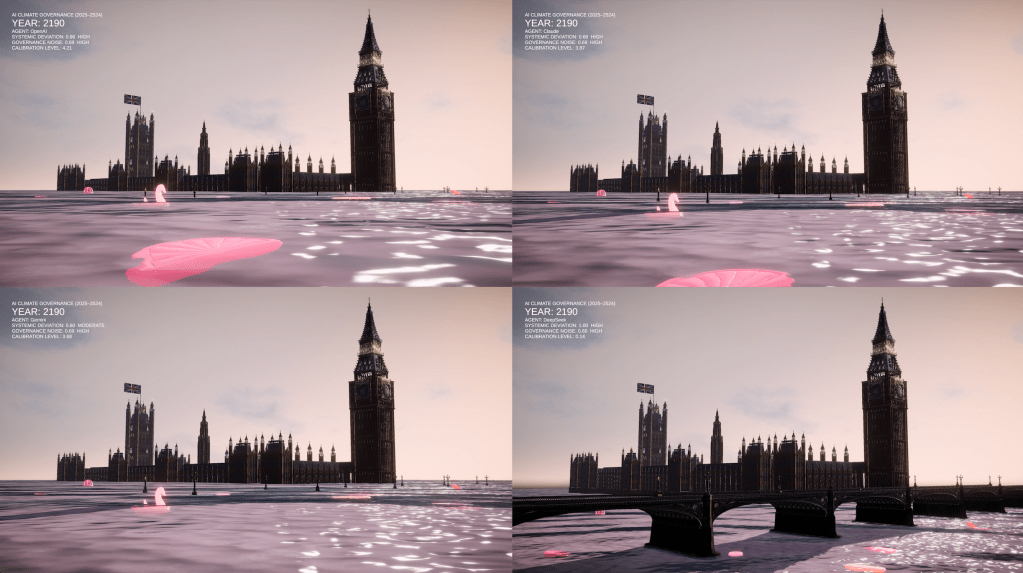
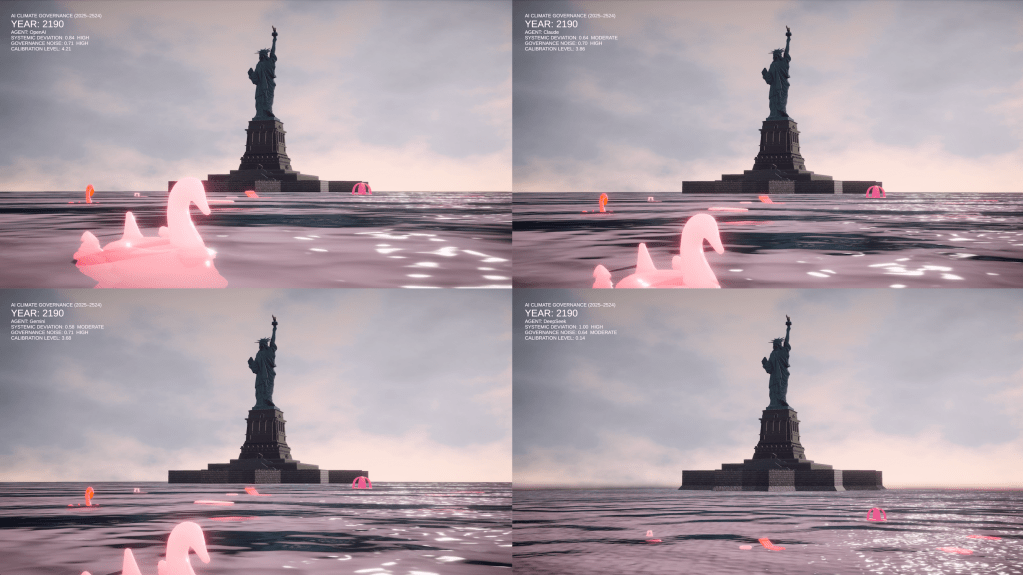
AI Climate Governance (2025–2524)
Medium: 2D and 3D Animation (Installation)
Year:2025-2026
AI Climate Governance (2025–2524) constructs a future parable in which non-human intelligence takes over the governance of global warming. The work begins with global climate and social data from 1950 to 2024, introducing four AI agents as governing subjects that independently make decisions about climate governance over the next five hundred years. Through this process, the system continuously projects changes in a speculative world, including temperature, CO₂ concentration, sea level, forest coverage, economic activity, and social stability. From these projections emerges a set of governance indicators distinct from human experiential scales, used to characterize the governance state of non-human intelligence. Extending the artist’s sustained engagement with posthuman narratives, the work explores how the world might be reconfigured when the subjects of understanding, interpretation, and governance shift from humans to non-human intelligence. It asks whether a future projected by AI has already begun to acquire the power to define the present—and even to rewrite the past.
Currently, the project consists of two distinct versions:
Version 1.2.V1: AI Climate Governance (2025–2524)
Version 1.1.V1: AI Climate Governance: Retroactive Present (2025–2524)

Version 1.2.V1 (3D) | AI Climate Governance (2025–2524)
Medium: 3D Animation (Installation)
Year:2025-2026
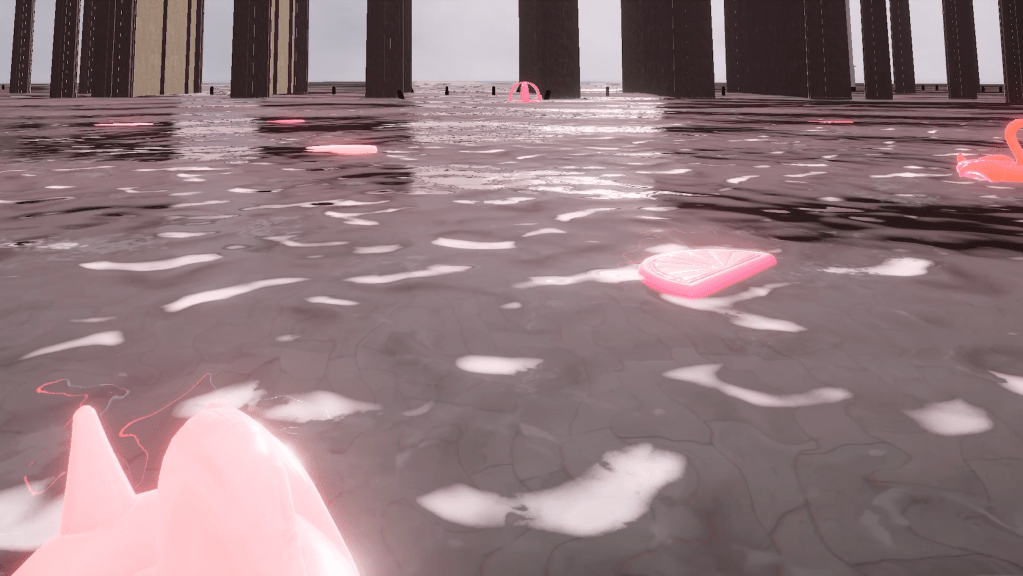
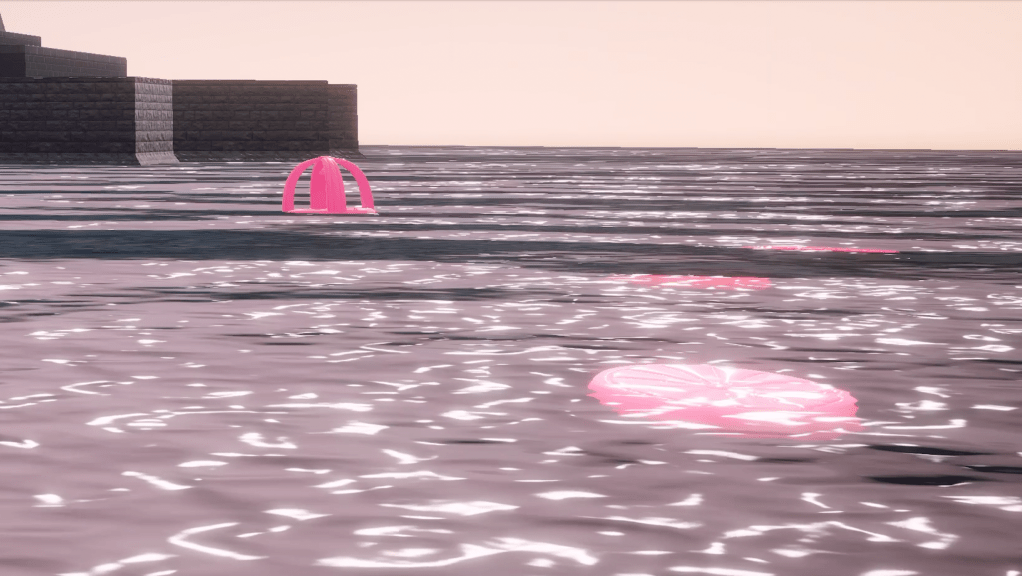
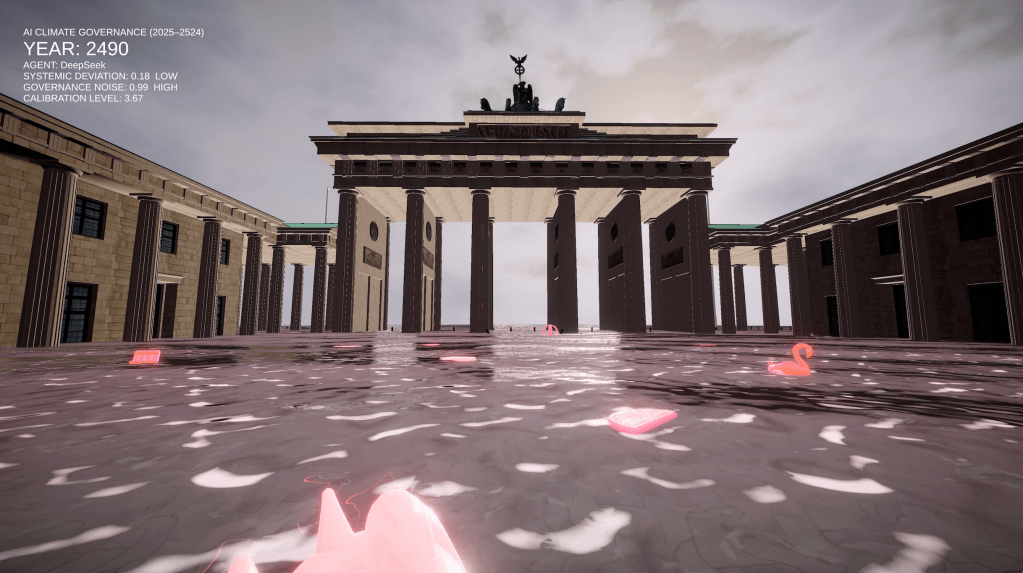
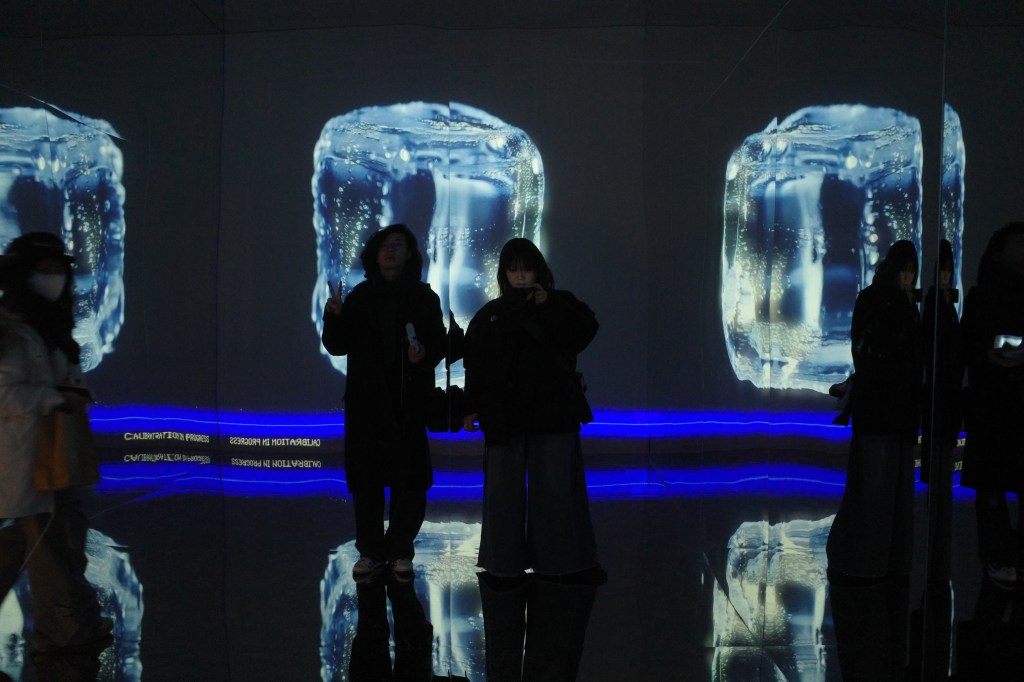
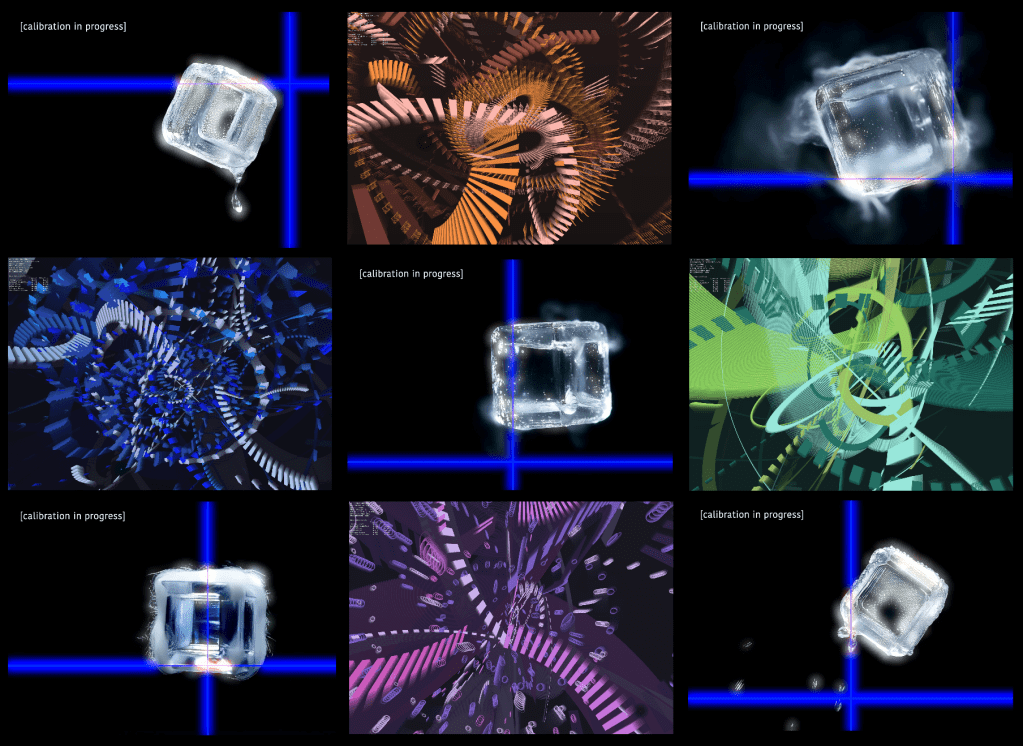
In version 1.2.V1, governance logic is translated into an environment that can be directly sensed, unfolding within realistic urban space and articulated through “water level” as the ongoing calibration of a non-human governance system in response to overall systemic deviation.
Version 1.1.V1 (2D) | AI Climate Governance: Retroactive Present (2025–2524)
Medium: 2D Animation (Installation)
Year:2025
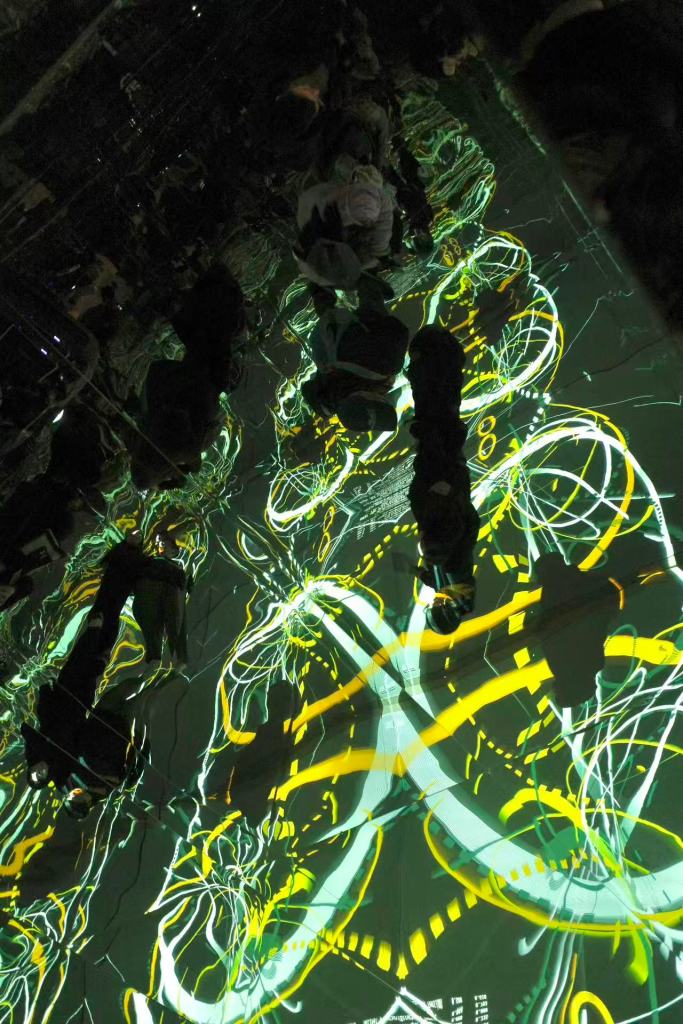
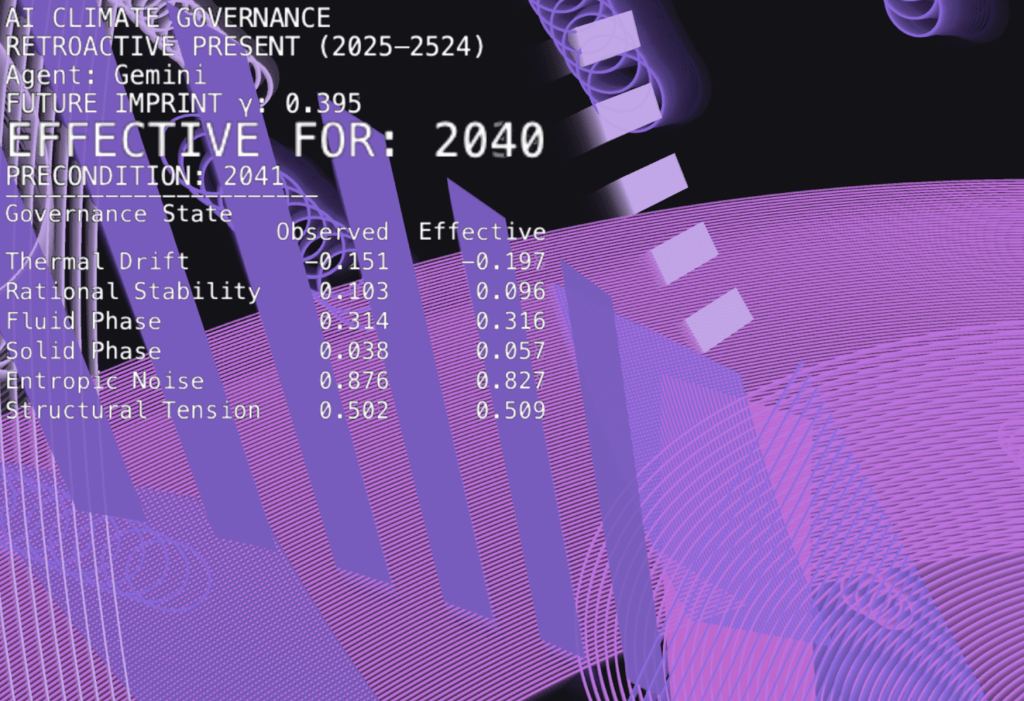
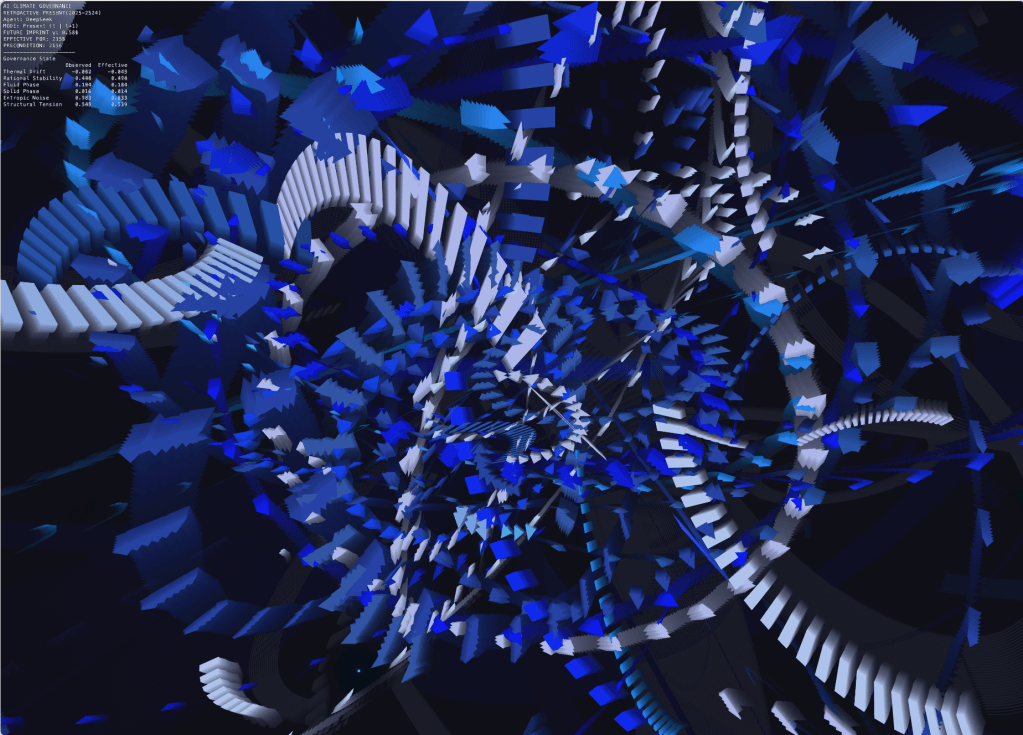
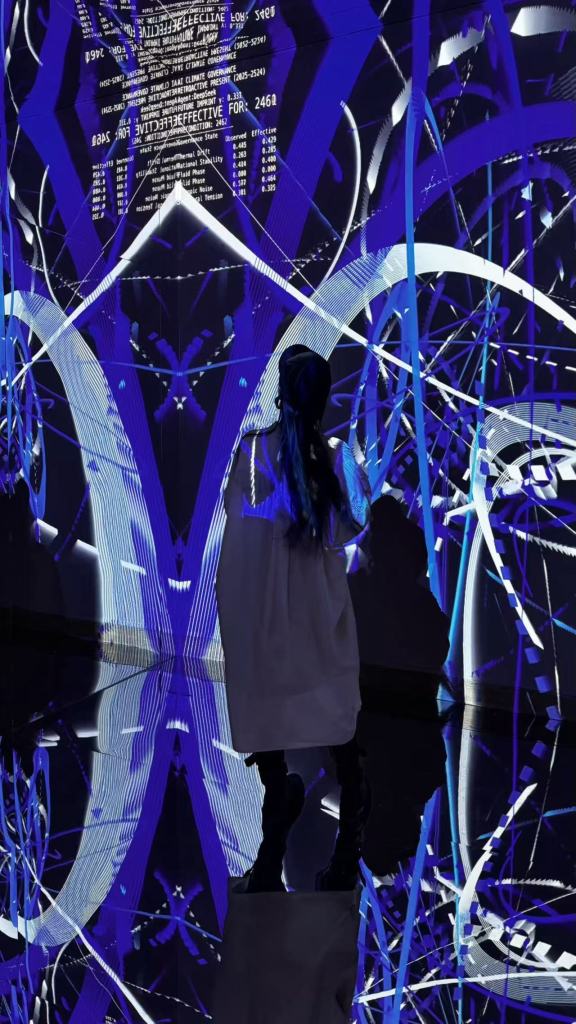
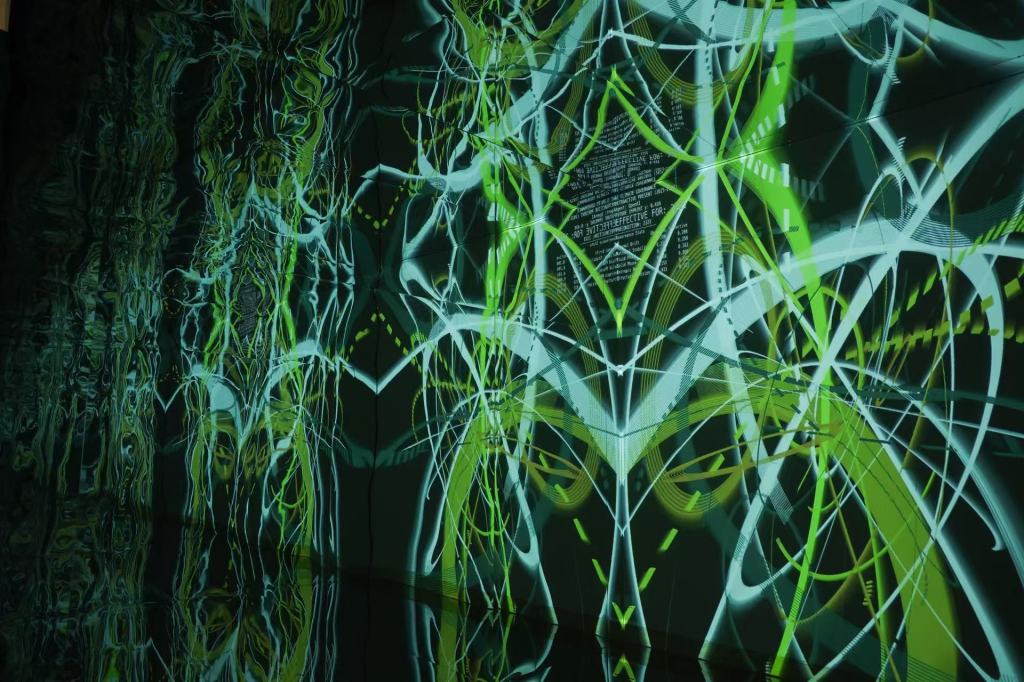
In version 1.1.V1, each “present” rendered through visual languages such as light delay, color temperature drift, and structural convergence and dispersion is not a simulation of future climate conditions. Instead, it represents a state that is permitted to appear only after being continuously recalibrated according to the governance evaluation criteria of the following year—a present shaped retroactively by future projections. In other words, the “now” encountered by the viewer is itself derived from a projected future.
Technical Framework
AI Climate Governance (2025–2524) is built upon a computational system that combines historical climate data, AI governance decision-making, and long-term world simulation. The system explores a speculative scenario in which non-human intelligence governs climate change over an extended temporal horizon, translating this governance logic into perceptible visual and spatial forms.
The system begins with a historical baseline constructed from global climate and socio-economic data between 1950 and 2024, including six variables: global temperature, CO₂ concentration, sea level, forest coverage, economic activity (GDP), and social stability. These data are used to train the ZHI world evolution model, which functions as the simulation engine of the project.
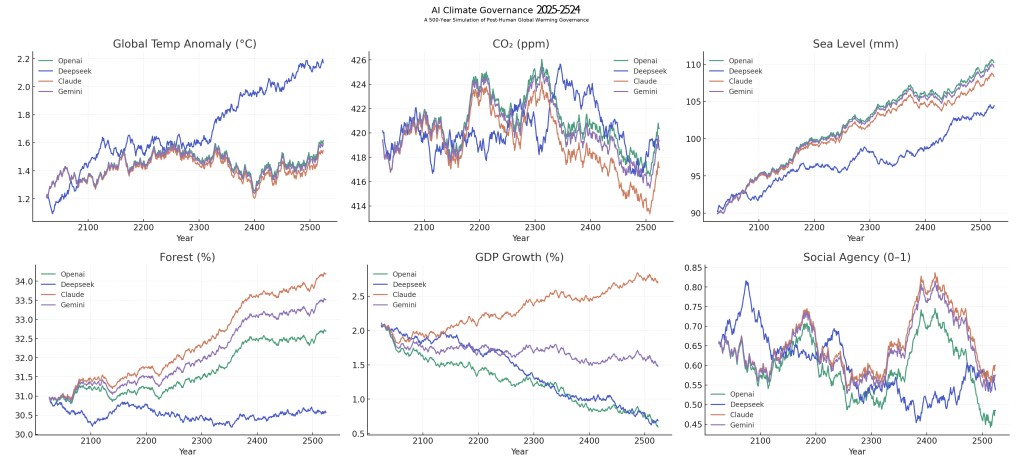
On this foundation, four AI agents—DeepSeek, OpenAI, Claude, and Gemini—are introduced as governing entities. Each agent independently makes governance decisions under the same planetary conditions, operating through three governance variables: environment, economy, and order. Their decisions are continuously processed by the ZHI model, which generates the next year’s world state. Through this iterative mechanism, the system produces a five-hundred-year simulation of planetary evolution.
The evolving world states are further translated into a set of governance indicators—Thermal Drift, Rational Stability, Fluid Phase, Solid Phase, Entropic Noise, and Structural Tension—representing how a non-human governance system interprets systemic deviation and stability.
The work introduces a retroactive temporal structure, in which knowledge of future governance states is used to recalibrate the present. The “present” encountered by viewers is therefore not a naturally unfolding moment, but a state shaped retroactively by projected future conditions.
Two versions of the work translate this governance logic into perceptual form.
•Version 1.1.V1 renders the system through abstract visual structures driven by topology, temporal motion, and perceptual noise, revealing a present continuously recalibrated by future governance.
•Version 1.2.V1 translates the same logic into a spatial environment using real urban landmarks, where dynamic water levels and atmospheric parameters express the ongoing calibration of planetary conditions by a non-human governance system.
 HAN YAJUAN+